What does a 3D scan of a factory hall deliver?
In a laser scan of a hall, a sensor measures a very large number of distances and assembles them into a point cloud. This is a three-dimensional representation made of measurement points that shows walls, columns, roof, machines, pipes, ventilation ducts and cable trays in their actual position. The point cloud of the hall is therefore an as-built survey that shows what is actually in the hall, regardless of the state of the drawings.
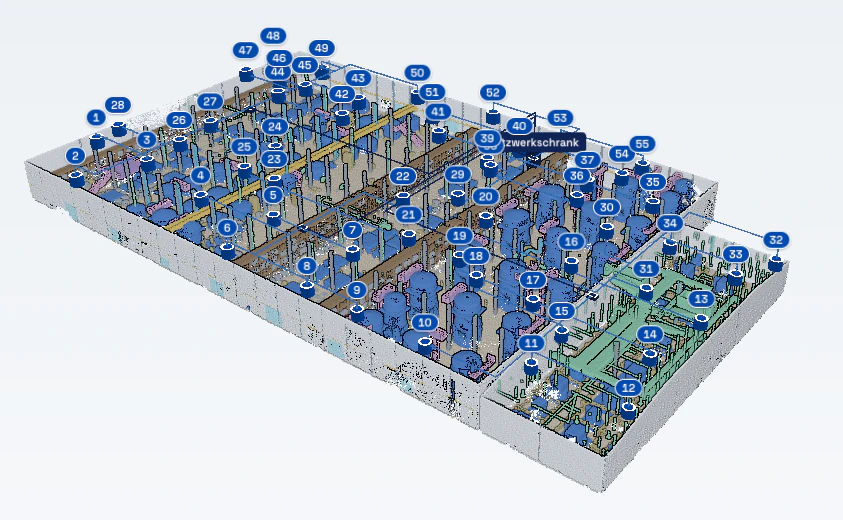
- Blue: Equipment and machinery
- Light blue: Pipework
- Green: Building services (MEP)
- Brown: Racking
- Purple: Platforms and stairs
- Yellow: Crane systems
- 12Blue numbered marker: Ceiling scanners
- Blue line: Cable routes
Plants need this as-built survey of the production hall above all for:
- Layout planning: plan new lines and equipment on the actual as-built state, not on the drawing from the last retrofit (more on this under Factory layout planning).
- Utility planning: capture pipes, ventilation ducts and cable trays as they are before new utilities are routed (see Fab & utility planning).
- Clash detection: check new equipment against the current scan in advance, before construction starts.
- Documentation: show what the hall looked like at a particular point in time.
- Digital models: anyone who wants to digitise a production hall uses the point cloud as a basis, for example for BIM models.
How are production halls usually scanned today?
Anyone who wants a hall scanned often commissions a service provider. Depending on the task, this means a terrestrial laser scanner on a tripod, a mobile hand-held SLAM scanner or photogrammetry. Smaller areas are also measured with a tape measure or a laser distance meter. The process is usually similar: agree a date, capture in the hall, then process the point cloud.
This delivers good results, but it remains a snapshot. As soon as a machine is moved, a line is rebuilt or a utility route is added, the recorded state no longer matches reality. Added to this are the effort of commissioning and scheduling, tripods in the hall and, depending on the area, barriers. In halls that change often, a new scan is therefore frequently postponed, and planning runs on outdated data.
How does 3D scanning of a factory hall work with LYTHEON?
LYTHEON consists of two components: the scanning system LYTHEON One and the platform LYTHEON Forge (details under System). With One, proven, commercially available 3D scanners are permanently mounted on the hall ceiling as off-the-shelf devices. The 3D LiDAR sensor used is the Livox Mid-360S. One click in Forge starts all scanners at the same time. After 15 seconds the entire hall is captured. Forge merges the captures into one point cloud and stores each scan as a dated state.
Because nothing has to be set up, the scan can be repeated at any time without a survey appointment. You choose the time yourself, for example at a shift change. This produces a series of dated states of your hall instead of a single capture.
| Criterion | One-off scan with tripod or hand-held device | LYTHEON |
|---|---|---|
| Preparation | Commissioning and scheduling | One-off: simulation, installation, setup |
| Capture in the hall | Tripods or walk-through, barriers depending on the area | Scanners on the ceiling, nothing to set up |
| Duration of the scan | Depends on hall size and method | 15 seconds for the entire hall |
| Repeat scan | New commission | One click, at any time |
| Result | One state at the time of capture | Dated states, one point cloud each |
| Particularly suitable for | One-off detailed captures, very high accuracy requirements | Halls that change frequently |
The process in three steps
- Simulation. Our in-house Synthetic Engine simulates your hall in advance and defines the number and position of the scanners. You receive initial simulation data and a fixed price for the implementation. If needed, we also survey the hall once on site.
- Installation and setup. LMS mounts the scanners at the simulated positions and sets up Forge for your hall. This happens once.
- Scan and plan. One click starts all scanners, after 15 seconds the hall is captured, and your planning starts from the current as-built state.
Planning, installation, software and training come from a single source, so you have one point of contact. You can also find the process on the home page.
What to look for when choosing a 3D scanning solution for factories
Five questions help you decide whether a service provider, a mobile device or a permanently installed system suits your hall.
How often does your hall change?
If little changes, a one-off scan is often enough. If the hall is rebuilt regularly, a system that can be repeated without an appointment is worthwhile, so that as-built data does not go out of date.
How large is the hall and how high is the ceiling?
Permanently installed scanners need a line of sight to what they are meant to capture. Hall area, ceiling height, columns and large items of equipment determine how many scanners are needed and where. According to the manufacturer (per sensor), the Livox Mid-360S offers a range of 40 m at 10% reflectivity and a field of view of 360° horizontal × 59° vertical. We define the number and position with the Synthetic Engine to suit your floor plan and ceiling height.
What accuracy do you really need?
For positioning equipment and routing utilities, a current and complete as-built record often matters more than the last millimetre. Manufacturer specifications per sensor: range precision ≤ 2 cm at 10 m (1σ), angular precision < 0.15° (1σ). The accuracy of the merged hall scan also depends on layout and installation. The full datasheet from the manufacturer opens in a new tab.
Does production keep running during the scan?
Ask every provider about setup, barriers and the duration of the capture. With LYTHEON, the scanners hang from the ceiling, a scan takes 15 seconds, and you decide when it happens. According to the manufacturer, the sensor operates with laser class 1 (eye-safe).
Where is your data stored?
Clarify where point clouds are stored, who has access and how earlier states can be found again. Forge stores each scan as a dated state. To derive BIM models, we are developing LYTHEON Core, a local AI computer on which the data stays inside the plant network. Core is in development and is not yet available.
When a conventional scan is the better choice: For one-off detailed captures with millimetre-level requirements, for example on individual machines or components, a terrestrial laser scanner on a tripod can make sense. LYTHEON aims at current as-built data for the entire hall, not at detailed captures. For an overview of the methods, see Laser scanning methods compared.
Which halls and industries benefit from 3D scanning?
3D laser scanning of production halls pays off particularly for halls that change constantly and for teams that work continuously with current as-built data: planning, facility and factory planning teams. Typical fields of application are:
- Semiconductors and electronics
- Automotive and suppliers
- Machinery and plant engineering
- Logistics
How a current hall scan supports the re-planning of lines is described in Factory layout planning. For pipes, ventilation ducts and cable trays, see Fab & utility planning.
Next step: see LYTHEON in the demo
We will show you LYTHEON Forge in a free cloud demo using a sample dataset. The demo is held online and without obligation, and your planning team is welcome to join. Open questions about price, scanners or the demo are answered in the frequently asked questions on the home page.